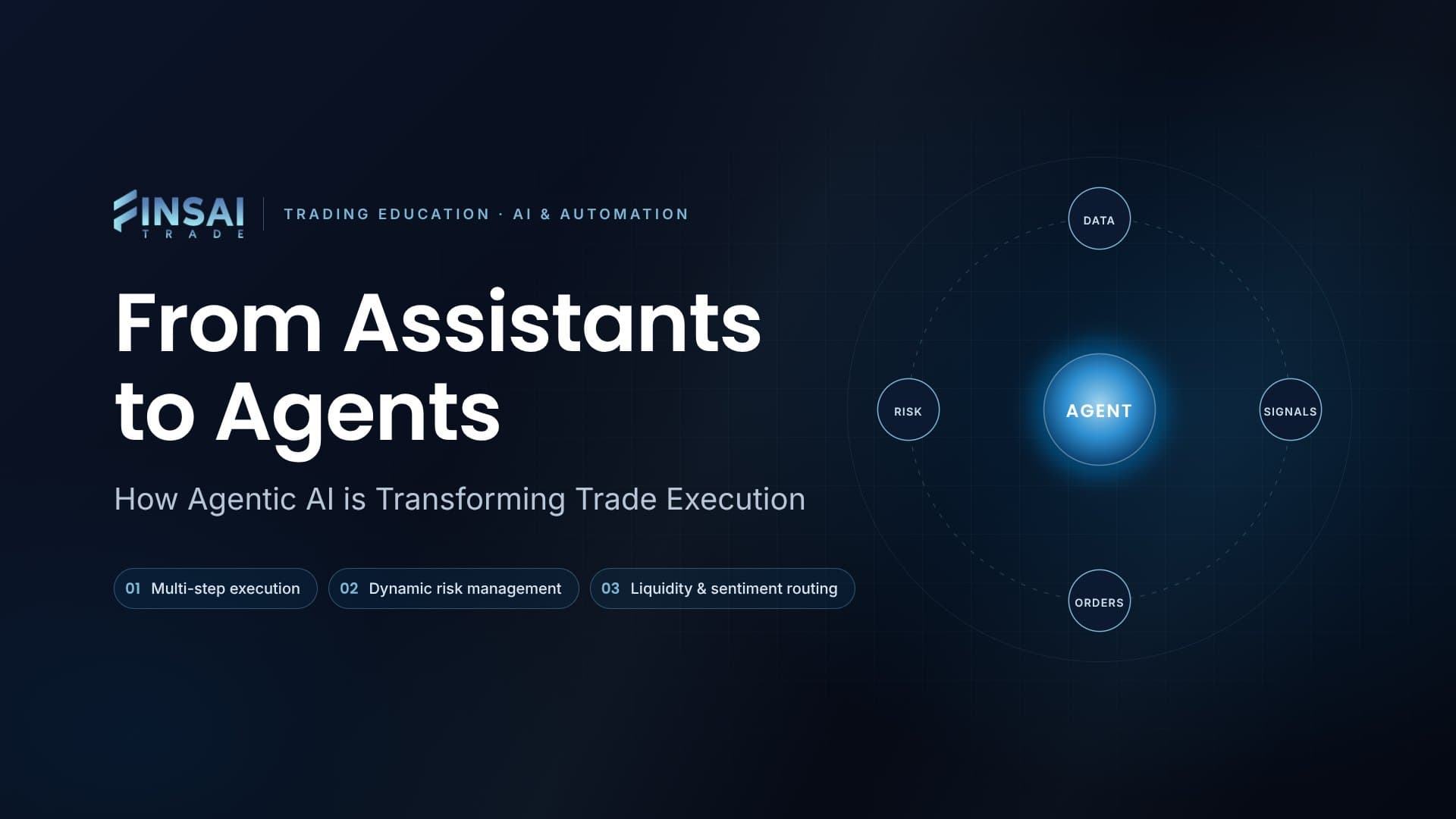
From Assistants to Agents: How Agentic AI is Transforming Trade Execution
Discover how Agentic AI moves beyond basic chatbots to automate multi-step trading strategies, manage dynamic risk, and execute trades on Finsai Trade.
On this page
Unlike traditional financial chatbots that answer static questions, Agentic AI in trading autonomously analyzes market data, executes multi-step algorithmic strategies, and manages portfolio risk continuously within user-defined parameters. As highlighted at the Global Fintech Fest, this marks a fundamental shift from passive financial research to proactive, automated trade execution.
What is Agentic AI in Financial Trading?
For years, artificial intelligence in trading platforms meant standard chatbots or passive stock screeners. You would ask a question like "What is the 50-day moving average for tech stocks?" and receive a static answer or chart. You still had to manually review the data, calculate position sizing, set up stop-loss orders, and push the execute button yourself.
Agentic AI in trading changes this workflow completely. Instead of relying on static prompts, an autonomous trading agent works toward active goals. It continuously monitors incoming tick data, order book depth, and macroeconomic headlines in real time. When specific conditions match your strategy, the agent doesn't just send a push notification; it evaluates the risk, calculates optimal order routing, and completes the action autonomously.
This evolution marks a shift from passive research tools to active AI trading execution platforms, giving retail and institutional traders execution efficiency that was once reserved for high-frequency quantitative desks.
Copilots vs. Autonomous Agents: Key Differences
To understand why this shift matters, it helps to compare generative AI copilots with true agentic frameworks:
| Feature / Capability | Assistive AI (Copilots & Chatbots) | Agentic AI (Autonomous Agents) |
|---|---|---|
| Primary Function | Text generation, basic Q&A, and chart plotting | Autonomous decision-making and execution |
| Execution | Manual user intervention required for every trade | Self-executes orders based on preset guardrails |
| Monitoring | Passive; responds only when queried | Continuous 24/7 scanning of volatile markets |
| Workflow Scope | Single-turn response (Question → Answer) | Multi-step algorithmic trading (Data → Risk → Order) |
Key Takeaways from the Global Fintech Fest: Why 2026 is the Pivot Year
At the Global Fintech Fest 2026, the global finance community reached a clear consensus: the overwhelming volume of market data and intraday volatility makes manual execution inefficient. Traders can no longer process market signals, cross-exchange liquidity, and news feeds manually without incurring severe execution slippage.
However, the event also highlighted an essential principle: financial autonomy requires strict guardrails. Financial leaders agreed on the necessity of a human-in-the-loop trading AI approach. Rather than handing complete control to unpredictable machine learning models, modern platforms use AI agents that operate within strict, user-defined rules. The human trader defines the strategy and max risk thresholds, while the AI agent handles the fast-paced execution.
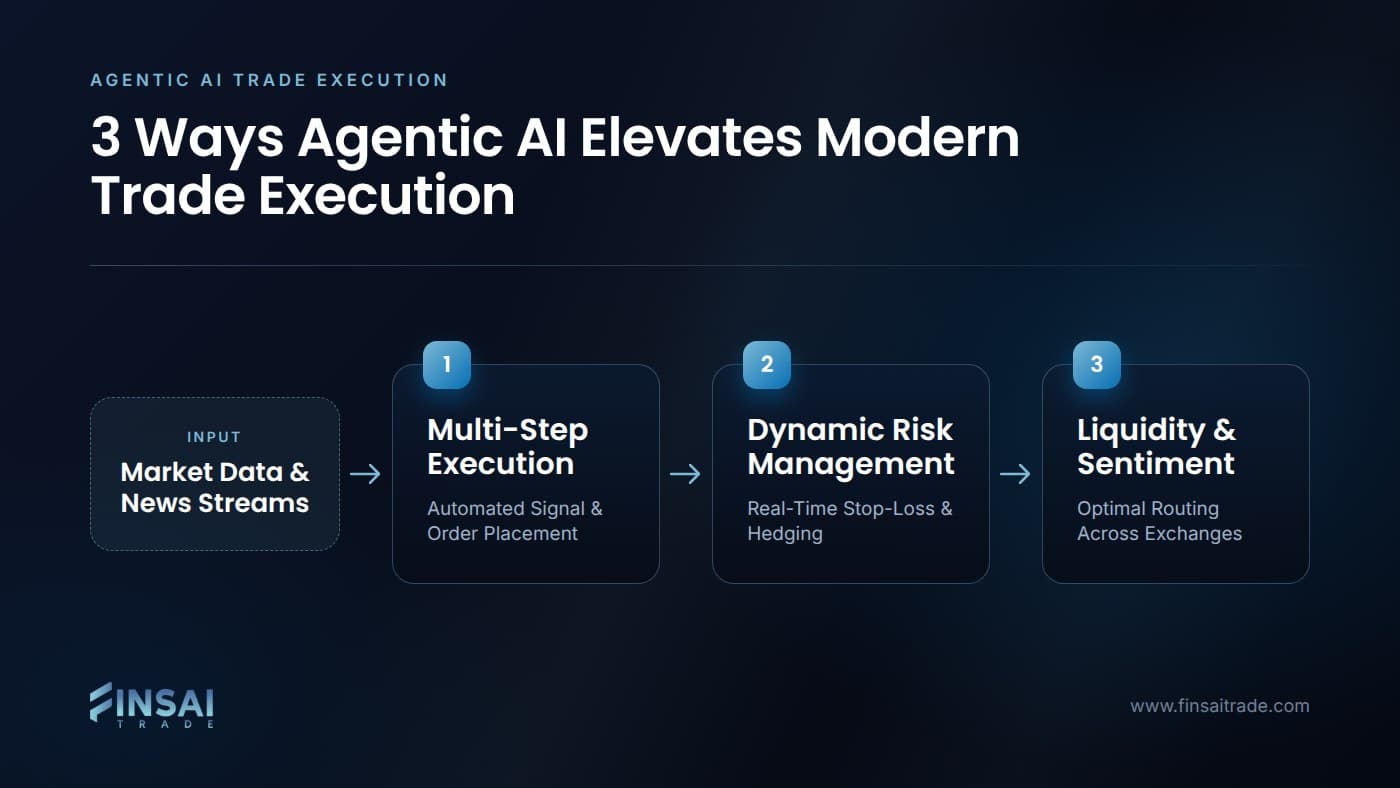
3 Ways Agentic AI Elevates Modern Trade Execution
1. Multi-Step Algorithmic Workflow Orchestration
Traditional algorithmic trading follows rigid, pre-coded "if-this-then-that" rules. Agentic AI trade execution goes further by managing complex, multi-step tasks across multiple systems. Through support for custom Expert Advisors (EAs) and algorithmic execution, an automated system can simultaneously scan order books for breakouts, cross-reference market sentiment from live news feeds, verify available capital, and split a large order into smaller slices to minimize market impact, all in a fraction of a second.
2. Autonomous Dynamic Risk Management & Stop-Loss Tuning
Static stop-loss orders are often caught out by sudden market wicks and unexpected volatility spikes. With autonomous risk management trading, modern tools constantly check portfolio risk against market volatility. If price action changes sharply, automated systems perform AI-powered stop-loss automation, dynamically adjusting trailing stop-losses to protect capital without requiring manual input.
3. Real-Time Liquidity & Sentiment Arbitrage
In fragmented markets, execution quality depends heavily on finding the best liquidity pools. Advanced agents continuously evaluate liquidity depth across exchanges. By pairing this structural view with real-time sentiment analysis, the agent avoids routing orders into low-liquidity traps or buying into temporary news-driven spikes, securing better overall execution prices.
Mitigating Risks: Governance, Security, and Compliance
While autonomous execution offers clear speed advantages, it also introduces operational risks such as market hallucination, execution triggers from bad data, or runaway trade loops. Solving these challenges requires robust AI trading compliance guardrails.
- Deterministic Circuit Breakers: Hard-coded limits on maximum position sizes, daily drawdown caps, and order frequency that the AI cannot override under any circumstances.
- Fail-Safe Isolation: If market data feeds become corrupt or unreliable, the agent instantly pauses active orders and reverts control back to the human trader.
- Verifiable Audit Trail: Every decision step made by an AI agent from initial signal detection to final order placement must be recorded in an immutable log for internal auditing and regulatory compliance.
What Safe AI Integration Looks Like in Modern Trading
As autonomous technologies mature across financial markets, safe integration relies on a balanced, hybrid approach that keeps human oversight central to execution. Modern industry standards prioritize key safeguards:
- Trader-Controlled Guardrails: Establishing clear, unalterable risk parameters including maximum drawdown caps, leverage limits, and asset restrictions before deploying automated strategies.
- Real-Time Visibility & Control: Maintaining continuous monitoring of automated order activity with single-click manual overrides and immediate account kill-switches.
- Transparent Execution Logic: Ensuring that trading models provide clear, audit-ready data regarding the technical indicators and risk metrics that trigger order execution.
To explore how these execution principles operate in practice, visit Finsai Trade's multi-asset trading platform.
Frequently Asked Questions
What is the main difference between standard financial AI chatbots and Agentic AI in trading?
Standard financial chatbots only answer questions or generate basic charts when prompted. Agentic AI acts autonomously, executing complex multi-step trading workflows, adjusting stop-losses, and managing risks continuously within pre-set human boundaries.
Is human oversight still required when using Agentic AI for trade execution?
Yes. Best practice guidelines established at events like the Global Fintech Fest emphasize a human-in-the-loop trading AI framework. Human traders establish policy rules, maximum drawdown limits, and strategies, while the AI handles execution within those parameters.
How does Agentic AI manage trading risks during sudden market volatility?
Agentic AI continuously tracks live market tick data against predefined portfolio risk tolerances. It can automatically adjust position sizes or update dynamic trailing stop-losses faster than a human trader could manually react.
What is the difference between multi-step algorithmic execution and traditional algorithmic trading?
Traditional algorithmic trading relies on static, rule-based scripts (e.g., executing an order when a price hits a moving average). Multi-step agentic execution dynamically chains multiple actions such as analyzing live news sentiment, evaluating cross-exchange liquidity depth, verifying portfolio risk, and splitting large orders into smaller slices all in real time without hard-coded human intervention.
How do compliance guardrails prevent Agentic AI from making runaway trades?
Compliance guardrails use deterministic risk rules operating alongside AI agents. These hard-coded circuit breakers enforce strict daily drawdown caps, maximum position limits, and latency kill-switches. If market data becomes unreliable or an agent attempts an execution outside specified safety parameters, the system instantly pauses trading and returns control to the human operator.
Can retail traders use automated execution on Finsai Trade?
Yes. Traders on Finsai Trade can implement automated trading strategies by connecting Expert Advisors (EAs) directly within MetaTrader 5 (MT5). This allows strategy automation while maintaining risk controls, custom stop-loss parameters, and full account authority.