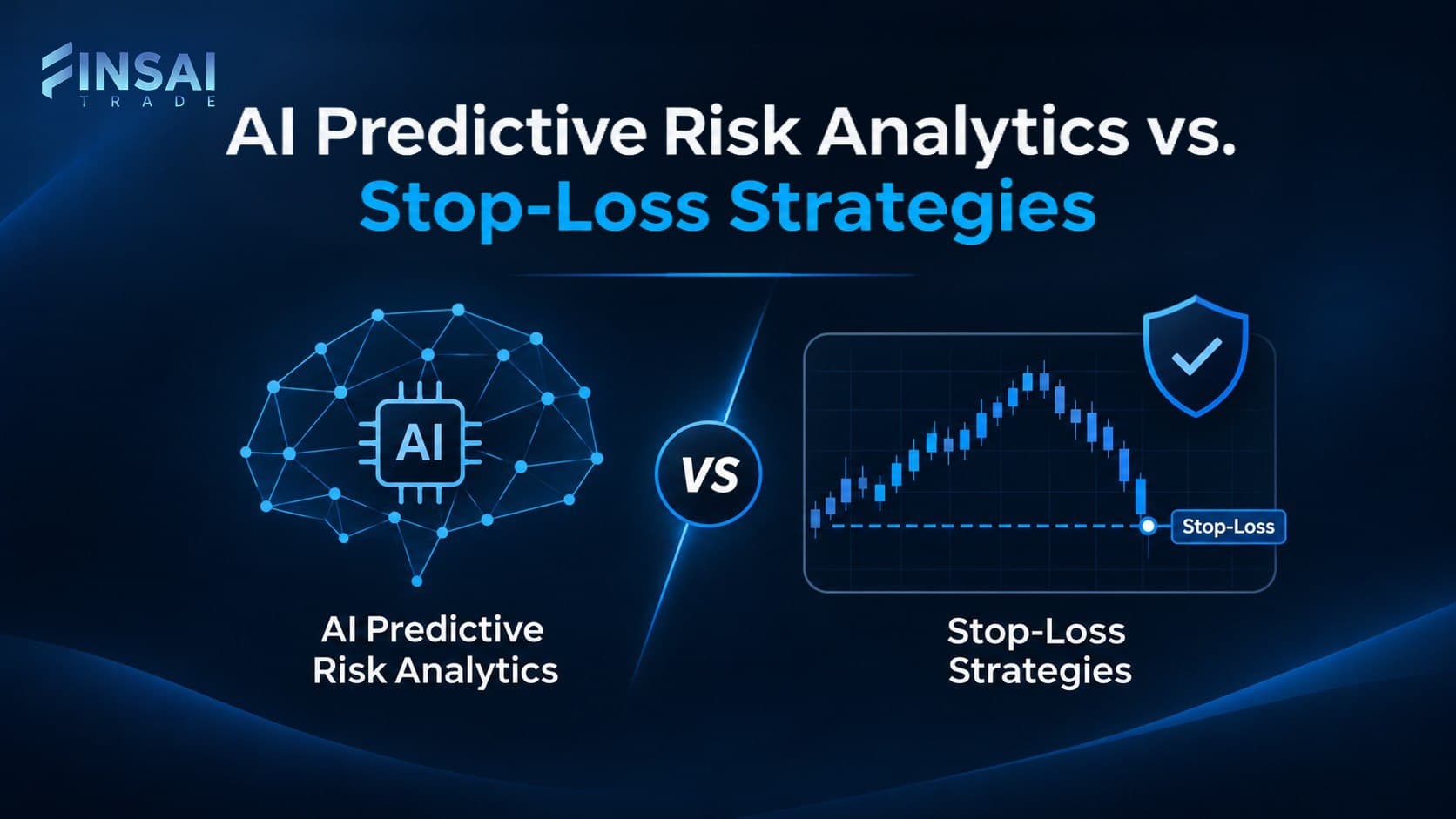
AI Predictive Risk Analytics vs. Stop-Loss Strategies
AI predictive risk analytics looks ahead; a stop-loss looks back. Learn how each works, where fixed stops fall short, and how to combine both.
On this page
AI predictive risk analytics looks ahead. A traditional stop-loss looks back. That is the core difference.
A stop-loss closes a trade after the price falls to a set level. AI predictive risk analytics uses data to estimate how risky the market is now and how that risk may change next. Neither tool is perfect. Most traders do best when they understand both.
This article explains how each one works, shows a recent case where fixed stops struggled, and offers a simple way to combine them. It ends with answers to common questions.
What Is a Traditional Stop-Loss, and Where Does It Fall Short?
A stop-loss is an order that closes a trade when the price reaches a level you choose. Buy a stock at $100, set a stop at $92, and the order triggers if the price hits $92.
The appeal is clear. It is simple. It removes emotion. It caps the size of one loss.
Still, traditional stop-loss limitations are real:
- It ignores market conditions. The same 8% stop applies in calm and in wild markets.
- It reacts to noise. A brief dip can close a good trade.
- It does not guarantee your price. In a fast fall, an order can fill far below your level.
- It acts late. The loss has already started.
What Is AI Predictive Risk Analytics?
AI predictive risk analytics uses machine learning to study past and live market data. Machine learning is software that finds patterns in data without being given every rule.
The models look at price swings, trading volume, and how assets move together. Then they estimate the odds of large losses. This is the idea behind market volatility risk modeling: measuring how wild the market is, and how wild it may get.
In practice, this can mean smaller position sizes when risk rises. Or it can mean an early warning of a drawdown, which is a fall from a recent peak. It can also mean an AI-driven stop-loss strategy, covered next.
How Do Dynamic Stop-Loss Algorithms Work?
A fixed stop uses one rule all the time. Dynamic stop-loss algorithms change the stop as conditions change.
A simple version ties the stop to recent price swings. If the average daily range of an asset doubles, the stop moves further away. If the market calms down, the stop moves closer. This helps avoid being shaken out by normal noise.
Machine learning versions go further. They can weigh many signals at once and update as new data arrives. The goal is the same: match the stop to the risk that exists today, not the risk you assumed last month.
AI Predictive Risk Analytics vs. Stop-Loss: Key Differences
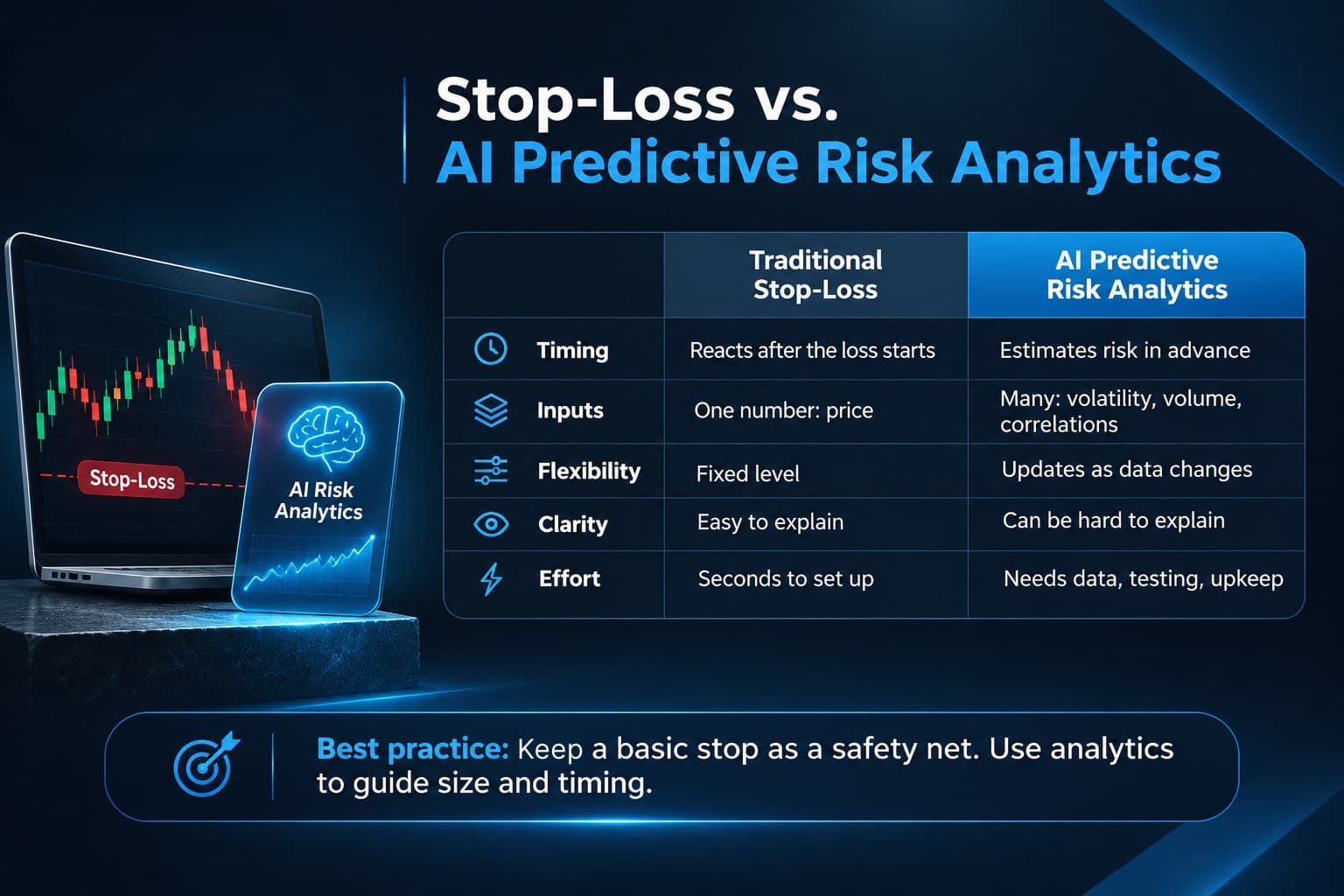
- Timing: A stop reacts. A predictive model estimates risk in advance.
- Inputs: A stop uses one number, the price. A model can use many.
- Flexibility: A stop is fixed. A model updates as data changes.
- Clarity: A stop is easy to explain. A model can be hard to explain.
- Effort: A stop takes seconds. A model needs data, testing, and upkeep.
Is AI better than a stop-loss?
Not always. AI can add context to what a fixed stop lacks. But it adds complexity and its own risks. For most traders, the better answer is to use a simple stop as a safety net and let analytics guide how much risk to take.
Case Study: Stop-Losses in the February 2026 Crypto Sell-Off
In early February 2026, Bitcoin fell hard. On February 5, it dropped below $64,000, down more than 13% on the day. That put it about 46% below its October 2025 all-time high.
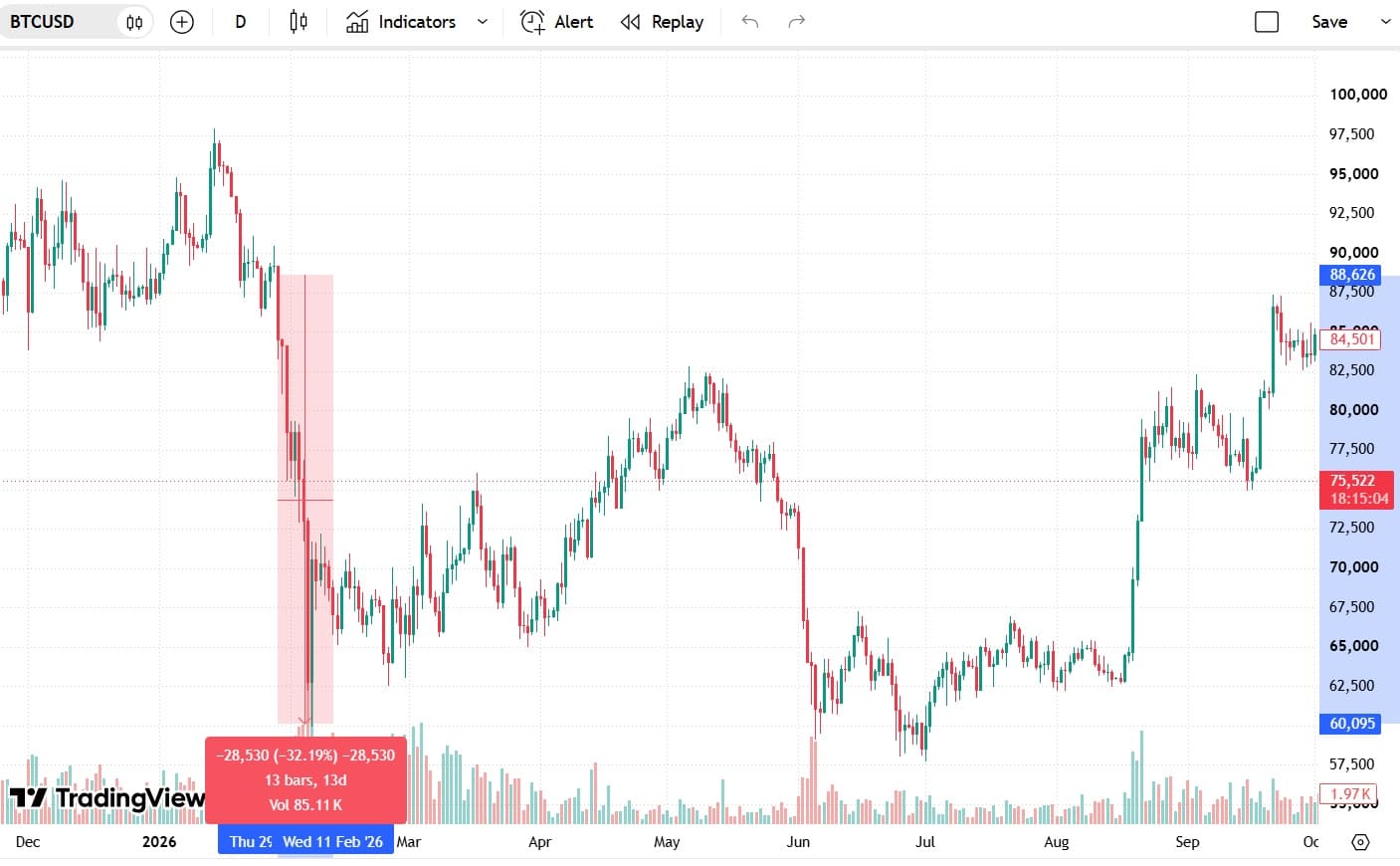
Leverage made the fall worse. Coinglass data showed over $1 billion in Bitcoin positions liquidated that day, on top of $3 billion in the previous eight days. A liquidation is a forced close. It happens when a leveraged trade loses too much of its margin.
IG's market analysis explained how the spiral worked. Traders had built up leveraged long positions. When the price broke below key support levels, stop-loss orders were triggered and liquidations sped up. The forced selling pushed prices lower than normal selling would have. That set off more stops. Axios added that a few buyers were stepping in.
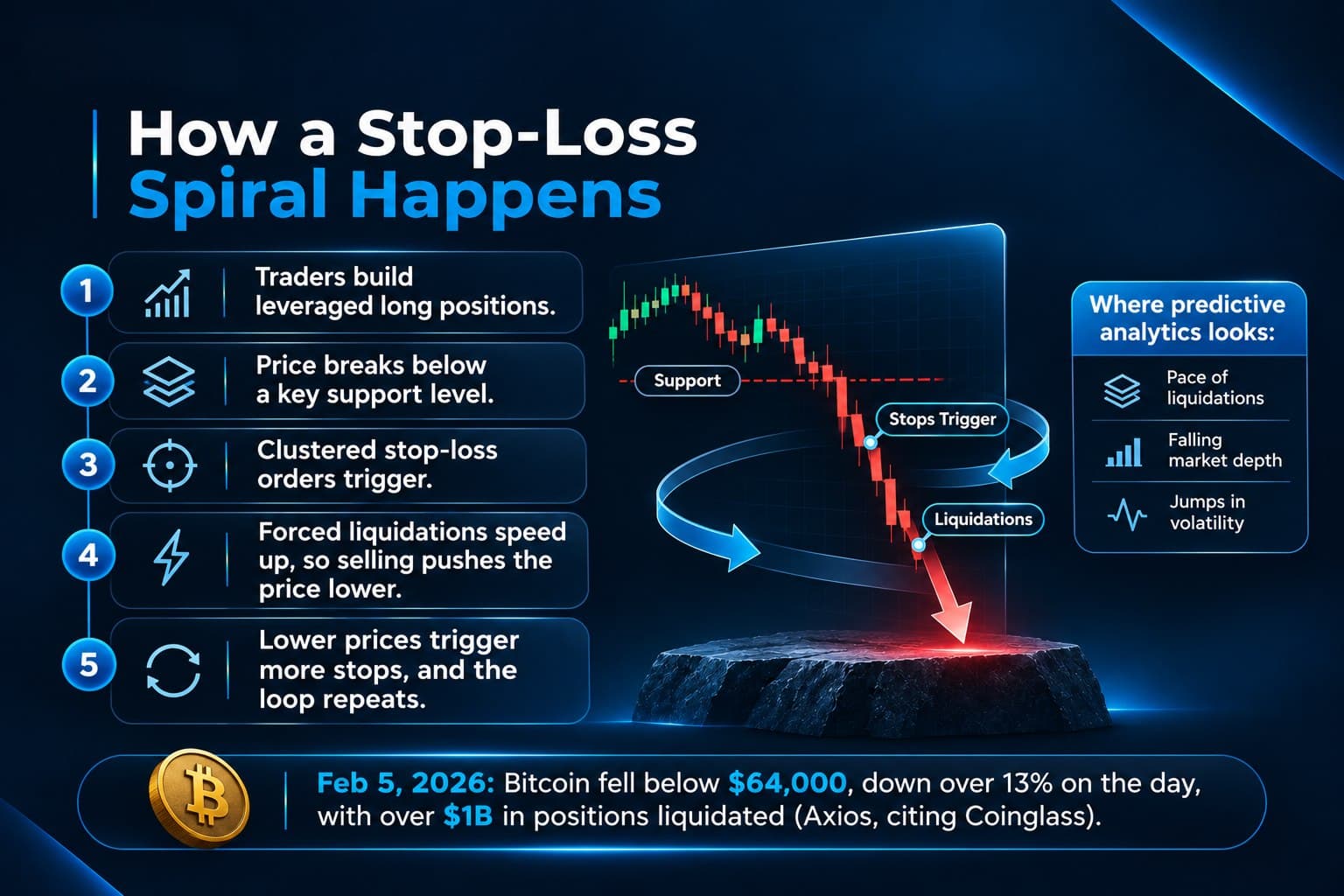
This pattern is common in fast markets. Stops placed just below well-known price levels tend to cluster. When the level breaks, many fire at once, and each one adds to the fall that triggers the next.
A fixed stop cannot see this. It does not know that positions are crowded or that buyers are thinning. A predictive model can track signals such as the pace of liquidations, falling market depth, and jumps in volatility. In principle, that can prompt a trader to cut leverage or size before the key level breaks. To be clear, this is how such tools are meant to work. It is not proof that AI would have avoided losses in February 2026.
Do Stop-Losses Work? What the Research Says
MIT researchers Kathryn Kaminski and Andrew Lo studied this question in a 2014 paper. They found that if prices move randomly, a simple stop-loss always lowers expected return. But when markets show momentum, or shift between distinct market regimes, stops can add value.
So a stop works in some conditions and not in others. A fixed rule cannot tell which one it is in. That gap is where predictive risk management aims to help.
How Common Is AI in Risk Management in 2026?
Adoption is growing fast:
- 81% of financial firms use AI at some level, and 40% have reached advanced stages, according to the Cambridge Centre for Alternative Finance's April 2026 survey of 628 organizations in 151 jurisdictions. That figure covers all uses of AI, not just risk.
- 73% of asset managers expect AI in risk management to speed up over the next three years, based on Clearwater Analytics' 2026 survey of 178 senior investment leaders.
The same Cambridge report lists unreliable outputs and lack of explainability among the top AI risks. That brings us to the downsides.
Where AI Risk Tools Can Go Wrong
- Models learn from history. A new kind of event can fool them.
- Overfitting. A model tuned too tightly to past data can fail in live markets.
- Black boxes. If you cannot explain why a model acted, it is hard to trust.
How to Combine Both Approaches
A practical setup for everyday traders:
- 1. Keep a hard stop. It is your safety net if a model or connection fails.
- 2. Size by volatility. Take smaller positions when markets are rough.
- 3. Use wider stops or stop-limit orders in thin markets. A stop-limit order sets a minimum sale price.
- 4. Test any model on data it has never seen.
- 5. Review results often and change what does not work.
Platforms such as Finsai Trade, which offers MT5, give traders standard tools like stop-loss and take-profit orders. The edge comes from how those levels are set, not from the order itself.
Conclusion
Stop-losses are simple, and that is their strength. They are also blunt. AI predictive risk analytics adds context about volatility and market stress, but it brings complexity and model risk.
The takeaway: use a basic stop as protection, and use predictive tools to decide how much risk to carry. Test everything first.
Sources
- Axios – Bitcoin sinks under $64K as new investors lose faith (Feb 5, 2026)
- IG – Major cryptocurrencies hit by sharp 2026 sell-off (Feb 5, 2026)
- Cambridge Centre for Alternative Finance – 2026 Global AI in Financial Services Report (April 2026)
- Clearwater Analytics 2026 Global GenAI Report, as reported by Financial Investigator (Aug 26, 2026)
- Kaminski & Lo – When Do Stop-Loss Rules Stop Losses?, Journal of Financial Markets 18 (2014)
Frequently Asked Questions
What is AI predictive risk analytics in trading?
It is the use of machine learning to estimate the chance and size of future losses. It studies price moves, volume, and volatility, then flags rising risk before a stop-loss would trigger.
How is predictive risk management different from a stop-loss?
A stop-loss reacts after the price hits a set level. Predictive risk management tries to estimate danger in advance. It can guide position size, stop distance, or when to stay out.
What is an AI-driven stop-loss strategy?
It is a stop that adjusts itself using model signals instead of one fixed percentage. The stop may widen when volatility jumps and tighten when markets calm.
What are the main traditional stop-loss limitations?
Fixed stops ignore market conditions, can trigger on short-term noise, and may fill far from the chosen price in fast markets. They also act only after a loss has begun.
How does machine learning risk management reduce losses?
It looks for patterns that often come before large drops, such as rising volatility or weak market depth. It cannot predict every event. Used well, it helps traders cut exposure earlier.
What is algorithmic drawdown control?
It is a rule-based system that limits how far an account can fall from its peak. For example, it may reduce position sizes automatically as losses build. Machine learning can help set those rules.
Can machine learning trading risk mitigation replace stop-losses?
Rarely. Models can fail on events they have not seen. Most risk-aware traders keep a basic stop as a backstop and use models to guide sizing and timing.
Why does market volatility matter for stop-loss placement?
In high volatility, normal price swings are larger. A tight stop gets hit by routine moves. In low volatility, a wide stop risks more than needed. Matching the stop to current volatility helps.