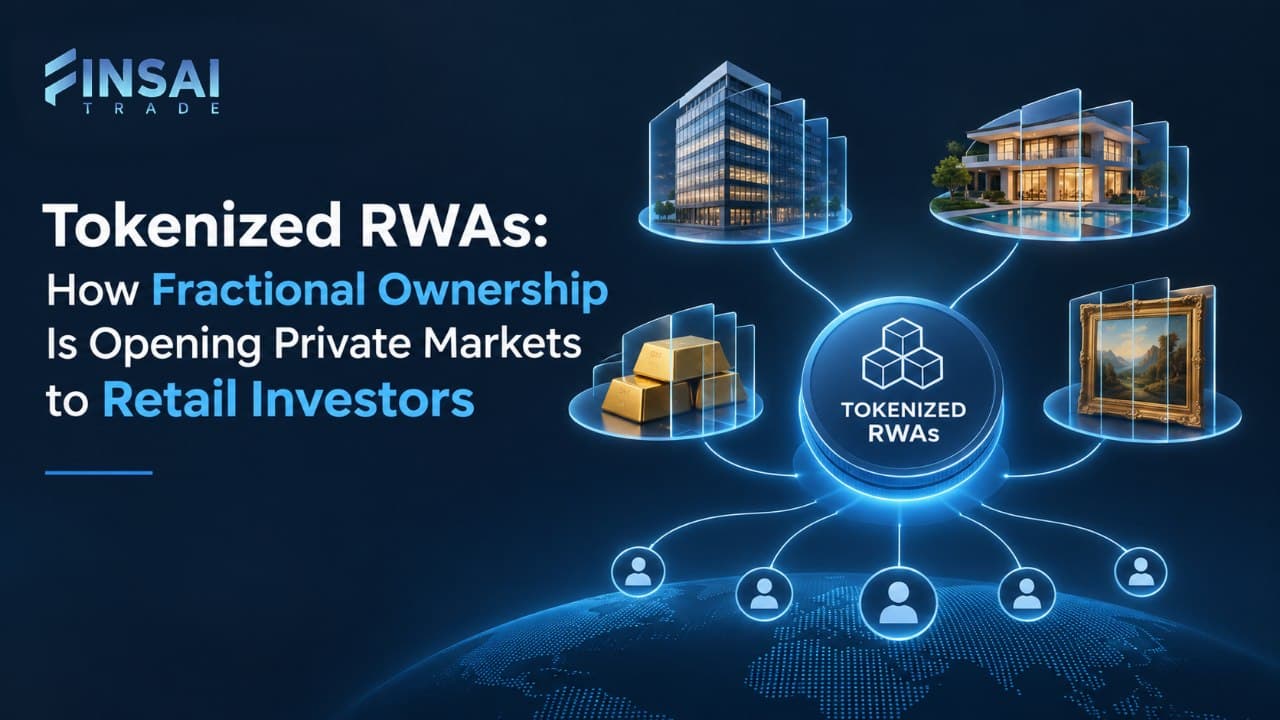
Tokenized RWAs: How Fractional Ownership Is Opening Private Markets to Retail Investors
Tokenized real-world assets let retail investors own fractions of buildings, bonds and loans. Learn how RWA tokenization works, where the market stands in 2026, and the risks to check.
On this page
Tokenized real-world assets (RWAs) are physical or financial assets, such as buildings, bonds or loans, represented as digital tokens on a blockchain. These tokens allow investors to own and trade fractional shares of an asset. This process is called real-world asset tokenization.
Their value on blockchains grew from about $6.4 billion at the end of 2024 to about $38.6 billion in September 2026, according to rwa.xyz data compiled by Stobox. Thanks to fractional ownership in private markets, tokenized RWA retail investing is now possible: ordinary people can reach assets once kept for big institutions.
Key Takeaways
- Tokenization is entering the mainstream: it is evolving from an experiment into a regulated investment market.
- Fractional ownership lowers entry barriers: investors can access alternative assets without purchasing them outright.
- Platform credibility matters: look for transparent ownership structures, verified reserves, independent audits and clear redemption processes.
- Liquidity is not guaranteed: check how easily you can resell your tokenized assets and whether a secondary market exists.
- Understand the fine print: check investor eligibility, fees, asset custody and regulatory requirements before investing.
What Are Tokenized Real-World Assets (RWAs) and Fractional Ownership?
To understand how tokenized assets work, it helps to start with two basic concepts: tokenization and fractional ownership.
Tokenization means creating a digital token that stands for a claim on a real asset, such as a building or a loan, and recording it on a blockchain. Fractional ownership means splitting that claim into small pieces, so you can own a slice of a building instead of all of it.
Here is how it compares with traditional private investing:
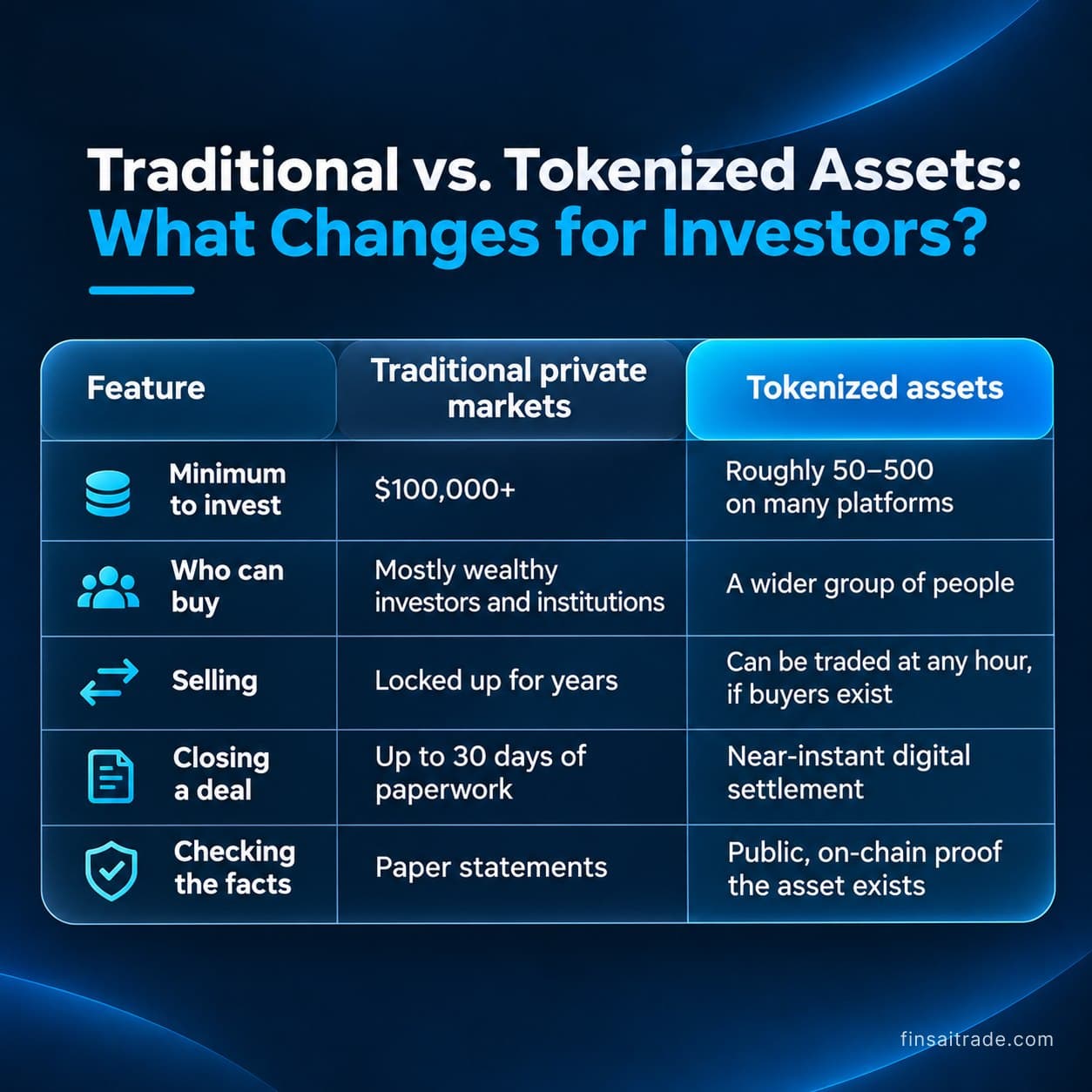
Treat the right-hand column as the best case. What you actually get depends on the platform, the legal setup, and whether anyone wants to buy from you.
Why Were Private Markets Traditionally Out of Reach for Retail Investors?
Private markets were mostly designed for large institutions and wealthy investors. Three key barriers kept everyday investors out.
1. High Investment Requirements
Many funds require an initial investment of $100,000 or more. In the US, accredited investor rules (generally $200,000 in annual income or $1 million in net worth, excluding your home) also limit who can participate.
2. Limited Liquidity
Private funds often lock in investments for five to ten years. Unlike stocks, these investments are not easily traded on an exchange. If investors need their money early, finding a buyer can be difficult.
3. High Fees and Complex Processes
Private investments often involve brokers, paperwork and multiple steps to complete a deal. These processes add costs and make investing more expensive for smaller investors.
How Does Real-World Asset Tokenization Work?
Behind every tokenized asset are three important components: a legal structure, rules governing who can hold the token, and a way to verify the asset's existence and value.
a. Legal Structuring and SPVs
The asset is placed in a separate company called a Special Purpose Vehicle (SPV). It holds the legal title and is kept apart from the platform's own finances, so it is built to survive if the platform fails. Your token is a share in that company, like a digital share certificate.
b. Permissioned Token Standards (ERC-3643 and On-Chain Identity)
Some tokens use the ERC-3643 permissioned token standard, which builds identity checks into the token. The token can only move to wallets that have passed ID checks (known as KYC) and are allowed to hold it. These standards are maturing: ERC-7943 became a final, approved Ethereum standard for real-world assets in May 2026.
c. On-Chain Valuation and Proof of Reserve
Services called oracles, such as Chainlink, send facts about the asset onto the blockchain. These include Proof of Reserve (a check that the asset really exists) and its current value. Independent audits and valuations back this up. An oracle only passes along what it is given, so trust still depends on the quality of the valuation and the custody.
RWA Market Data: Where Tokenization Stands in 2026
On-chain RWA value, not counting stablecoins, reached $38.6 billion on 27 September 2026. That is up from $33.5 billion in July, per rwa.xyz figures compiled by Stobox. If you count the real assets the tokens point to, the total is about $358 billion.
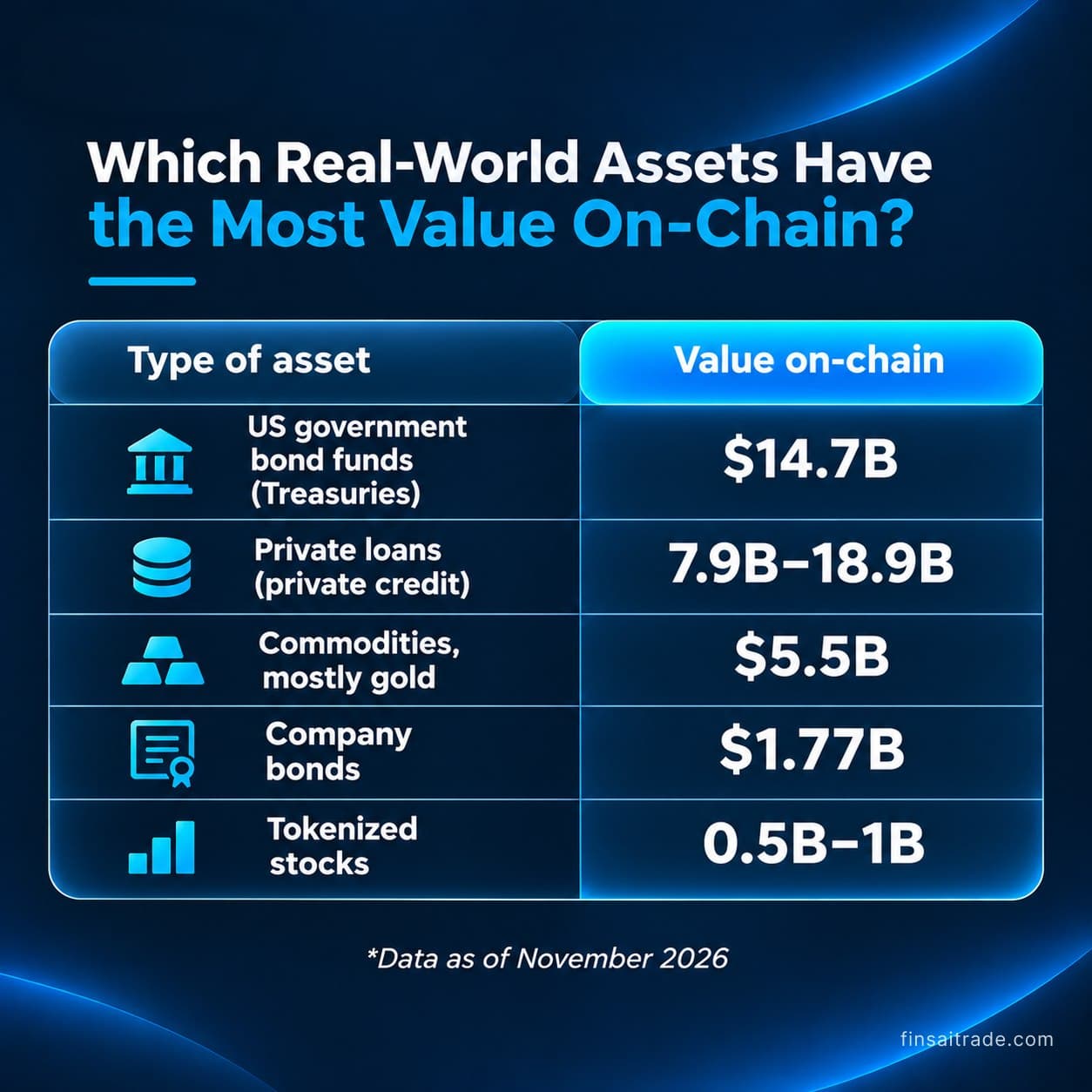
Rules have kept pace. In January 2026, the US SEC said tokenized securities are treated like any other securities. In March, Nasdaq won approval to trade tokenized versions of listed shares. In July, the EU's transition period for its MiCA crypto rules ended.
Forecasts vary a lot. McKinsey's main estimate is $2 trillion by 2030, while Standard Chartered expects $30.1 trillion by 2034.
Top Sector Opportunities for Tokenized RWA Retail Investing
- Fractional real estate: you earn a share of the rent and any rise in the property's value, with entry on some platforms from a few hundred dollars. It is also the hardest area to measure, since most deals are shares in a holding company.
- Tokenized private loans and income funds: these give access to company loans once open only to big funds. Maple alone has lent out more than $4 billion, but borrowers can fail to repay.
- Art and collectibles: small shares in famous artworks or rare goods help you spread your money into physical items. Prices are harder to judge and buyers are harder to find than in other areas.
- Treasury and money market tokens: the biggest category of tokenized yield assets gives steady, low-risk yield on dollar holdings, through products such as BlackRock's BUIDL and Ondo's USDY. Many still limit who can buy, so check you are eligible first.
How Is Dubai Making Tokenized Real Estate Accessible to Retail Investors?
Dubai offers one of the clearest examples of how real-world asset tokenization can work for everyday investors.
Dubai's Land Department (DLD) runs the most visible retail test so far. Its PRYPCO Mint platform, licensed by the Virtual Assets Regulatory Authority (VARA), lets people buy tokenized shares in finished properties for as little as AED 2,000, roughly $545.
Results so far
- The first property, an AED 2.4 million apartment in Business Bay, drew 224 investors from 44 nationalities and sold out within 24 hours.
- A second property, a one-bedroom in Kensington Waters, was fully sold in one minute and 58 seconds.
- On 20 February 2026, a resale market opened, running 24/7, covering about 7.8 million property tokens. DLD keeps token transfers matched with official property ownership records.
- DLD aims for tokenized property to make up about 7% of Dubai's market, around $16 billion, by 2033.
The lesson: linking tokens to a government land registry answers the biggest worry for retail buyers: who really owns the property. Quick sell-outs show strong demand, but they measure first sales, not exits. How easily people can resell is the number to watch next.
What Are the Risks of Investing in Tokenized RWAs?
Greater accessibility does not automatically make an investment safer. Investors need to understand the regulatory, liquidity and asset-related risks before committing money.
1. Fragmented Global Regulations
Rules differ from place to place. In the US, the SEC treats tokenized securities like any other securities, so each offer must follow an exemption or be registered. The EU uses its MiCA rules, and Dubai has its own VARA licence. An asset open to retail buyers in one country may be off-limits in another.
2. The Secondary Market Liquidity Illusion
Creating a token does not create buyers. One mid-2026 analysis found 56% of reported RWA value sitting idle, and Treasury and private loan tokens are mostly created and cashed in rather than traded between people. Trading is real where there is demand: tokenized gold had $90.7 billion in trading volume in Q1 2026, more than all of 2025.
3. Off-Chain Execution and Custody Risks
The blockchain protects the token, not the building. Returns still depend on property managers, legal custodians and valuers. Check who holds the title, who audits the assets, and what happens if any of them fail.
Conclusion
Tokenization has moved from experiment to regulated market, and fractional ownership is democratizing alternative investments for everyday people. The best platforms will combine low minimums with clear ownership, proven reserves and easy resale.
Before you invest, check if you are eligible, how the deal is set up, and who audits the assets. This article is general information, not investment advice.
Sources
- Stobox – The State of RWA Tokenization (rwa.xyz data, updated 27 September 2026)
- Khaleej Times – DLD launches first tokenised real estate project
- Metropolitan – DLD tokenization Phase 2 secondary market
- Cushman & Wakefield – Second tokenized offering sells out
- Unlock Blockchain – Dubai secondary market
- Menastartupdigest – PRYPCO Mint marketplace
- GlobeNewswire – ERC-7943 reaches Final status
- Decrypt – Nasdaq wins SEC approval for tokenized securities pilot
Frequently Asked Questions
Can retail non-accredited investors buy tokenized RWAs today?
Yes, but access depends on the jurisdiction and the deal structure. Many early RWA protocols restricted access to accredited investors under SEC Reg D. Newer platforms use retail-compliant structures, such as SEC Reg A+, European MiCA frameworks or offshore retail structures, to allow non-accredited investors to take part with low minimums.
Does owning a token give you legal ownership of the physical asset?
In most compliant RWA models, the token represents a legal beneficial interest or equity share in a Special Purpose Vehicle (SPV) or trust that holds legal title to the physical asset. The token acts as a digital share certificate, granting rights to cash flows, governance or liquidation proceeds.
How do retail investors earn returns on tokenized real-world assets?
Through two main routes: yield payouts, such as rental income from real estate or interest from private credit, often distributed in stablecoins via smart contracts; and capital appreciation, realised when selling fractional shares on secondary markets or when the asset is sold.
What happens to my tokenized asset if the tokenization platform goes bankrupt?
Properly structured RWA offerings hold the underlying assets in a bankruptcy-remote SPV or independent trust, separate from the tokenization company's balance sheet. If the platform fails, that legal structure is designed to preserve investors' claim on the underlying asset. Check the offering documents to confirm how this works for each deal.
How is asset valuation updated on-chain for fractional RWAs?
Through independent third-party appraisals and oracle networks such as Chainlink. Oracles relay off-chain data, such as bank balances and custodian audits, and publish Proof of Reserve (PoR) and Net Asset Value (NAV) updates to the blockchain.