Retail Algorithmic Trading: Bridging the Gap Between Retail Investors and Institutional Execution
Learn how retail algorithmic trading works, how it differs from institutional execution, and how APIs, smart order routing and latency affect trade results.
On this page
Retail algorithmic trading allows individual investors to use software and coded rules to place trades automatically. It brings some of the discipline used by institutional traders to retail markets. However, a major gap remains: institutions often have better access to execution speed, order routing and trading infrastructure.
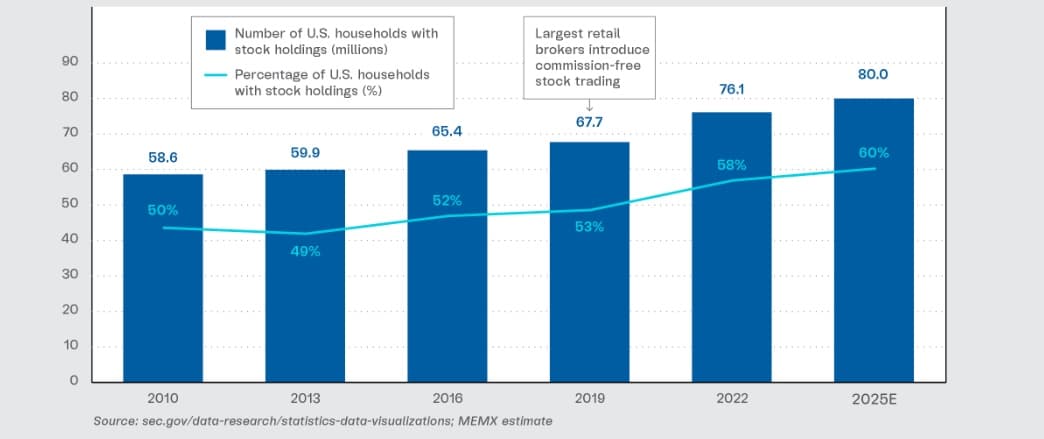
This difference matters because retail investors now account for a significant share of market activity. MEMX, a US exchange operator, estimates that retail investors contribute 30% to 37% of daily US equity trading volume. Other estimates are lower, with SIFMA putting the figure at 17.9% for 2024. These differences reflect how each organisation measures retail trading activity.
So, how can individual traders compete when institutions have access to better technology and execution systems?
This guide explains how retail algorithmic trading works, what separates retail and institutional trade execution, and seven practical ways to reduce execution costs.
Key Takeaways
- Retail algorithmic trading uses coded rules to automate buying and selling decisions.
- Institutional traders have access to advanced execution algorithms, direct market access and faster infrastructure.
- Order execution latency can cause slippage and reduce the actual returns of an automated trading strategy.
- Smart order routing helps find suitable trading venues, but retail traders usually depend on their broker for this service.
- Retail traders can improve execution by measuring slippage, testing APIs and using realistic backtesting assumptions.
- Automation reduces manual intervention but does not eliminate market risk.
What Is Retail Algorithmic Trading?
Retail algorithmic trading is the use of software and predefined rules to automatically place buy and sell orders through a broker. Instead of manually watching prices and clicking buttons, traders let a programmed strategy act when specific conditions are met.
For example, a trader can set a rule to buy when the 50-day moving average crosses above the 200-day moving average.
Retail quantitative trading takes this further by using statistical models and mathematical analysis to identify trading opportunities.
Some common automated trading strategies include:
- Trend following: Buying or selling in the direction of an existing price movement.
- Mean reversion: Trading on the expectation that prices will return towards their historical average.
- Portfolio rebalancing: Automatically adjusting investments to maintain a target asset allocation.
- Dollar-cost averaging: Investing a fixed amount at regular intervals, regardless of market prices.
What Software Do Retail Traders Need for Algorithmic Trading?
Retail traders can use no-code platforms, trading applications or custom Python scripts to automate strategies.
Many of these tools connect to brokers through an API (Application Programming Interface). An API allows two software systems to communicate and exchange instructions.
Broker API trade execution connects the trader's strategy to the broker's platform, allowing the software to send orders without manual intervention.
However, having access to an API does not automatically provide institutional-level execution. The broker's infrastructure, order routing and processing speed still affect the final result.
Why Is Algorithmic Trading Growing Among Retail Investors?
Algorithmic trading for retail investors is growing because trading tools are becoming more accessible, brokers are offering wider API access, and individual investors are contributing more market volume, between 17.9% and 37% of daily US equity volume, depending on whose estimate you use.
Another important development is where these orders are executed. According to MEMX, most retail trading volume goes through off-exchange retail wholesalers. Their share of industry volume increased from 27% in January 2024 to 34% in June 2025.
This makes execution quality increasingly important. The price a trader sees when placing an order may not always be the price at which the order gets filled.
How Does Institutional Trade Execution Differ From Retail Trading?
Institutional trade execution differs from retail execution mainly in how orders are divided, routed and processed.
Large institutions rarely send an entire order to the market at once. Instead, they use execution algorithms to divide large orders into smaller pieces. This helps reduce market impact and manage execution costs.
Three common institutional execution algorithms are:
- VWAP (Volume-Weighted Average Price): Divides an order based on expected trading volume throughout the day.
- TWAP (Time-Weighted Average Price): Splits an order into smaller trades placed at regular time intervals.
- Smart Order Routing: Automatically directs orders to trading venues based on factors such as price, available liquidity and the likelihood of execution.
Institutions may also use Direct Market Access (DMA), the FIX protocol and servers located close to exchange infrastructure.
Most retail traders, on the other hand, depend on broker APIs or trading platforms. Their brokers generally manage order routing and execution.
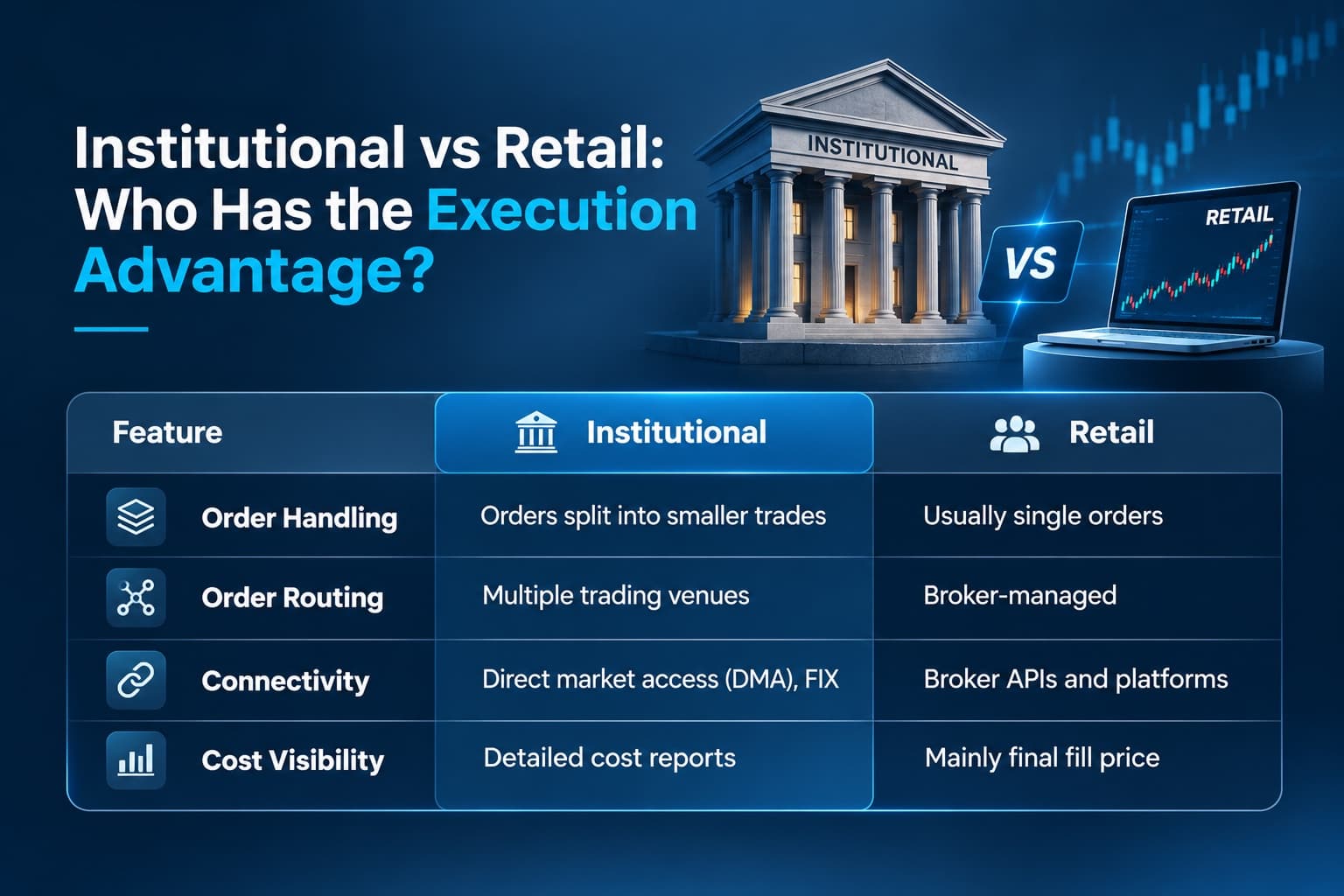
Retail orders are generally smaller, so their market impact is less of a concern. However, execution speed, routing quality and trading costs can still affect their results.
Why Does Order Execution Latency Matter in Retail Algorithmic Trading?
Order execution latency is the time delay between a trading system detecting a price and the exchange processing the order. Even a small delay can affect the price at which a trade gets executed.
This can lead to slippage, which occurs when an order gets filled at a different price than expected.
A 2025 study published in Quantitative Finance examined how latency affects trading performance. Researchers from the University of Oxford and other institutions sent more than three million small live orders to the Bybit exchange.
The study found that orders that would have been profitable were more likely to receive worse fills or fail to execute.
When researchers applied these findings to two example trading strategies, average short-term profits fell by approximately 17% and 30%, respectively, compared with results from naive backtests.
These findings need context. The study focused on cryptocurrency markets and fast-trading strategies. Slower retail strategies may experience smaller effects.
However, the central lesson applies more broadly: backtests that assume every order executes at the quoted price can overestimate actual trading performance.
The researchers also measured an average message travel time of approximately 2 milliseconds, even from a server located close to the exchange.
How Do Broker APIs and VPS Hosting Affect Trading Speed?
Broker API trade execution introduces another potential source of delay.
Retail trading APIs often have rate limits, which restrict how many requests a system can send within a given period. These restrictions can slow down strategies that generate several orders in quick succession.
A Virtual Private Server (VPS) located close to the broker can reduce network delays. However, it cannot eliminate the broker's internal processing time or exchange-side delays.
For retail traders, the goal should be to reduce avoidable latency rather than try to match institutional infrastructure.
What Is Smart Order Routing, and Can Retail Traders Use It?
Smart order routing is a system that automatically selects where an order should be sent based on factors such as price, order size, available liquidity and execution probability.
It helps traders find suitable trading venues without manually comparing every available option. So, essentially, your broker's routing system can affect how your orders get executed.
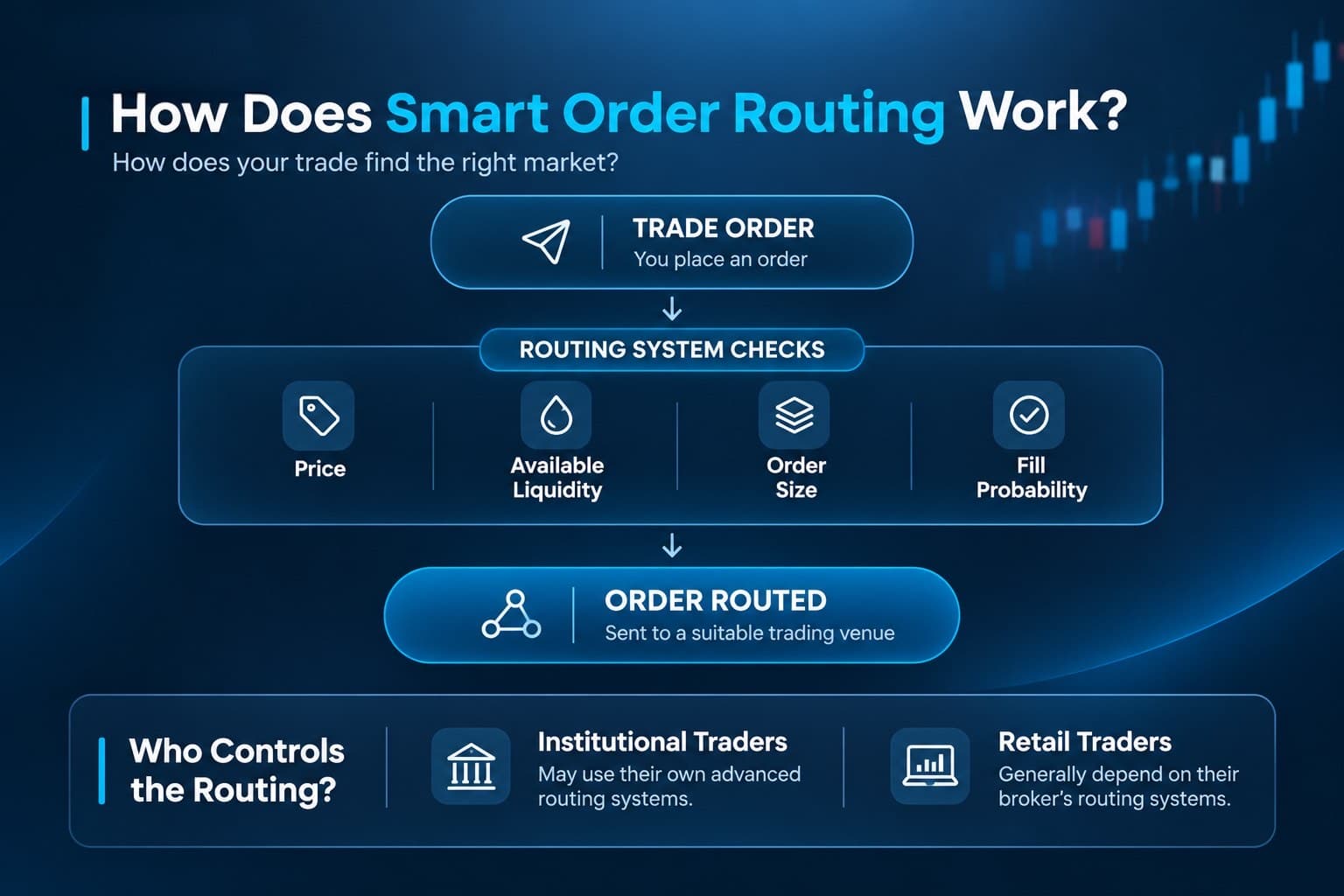
Most retail traders do not control this process directly. Their brokers handle order routing, which means the quality of execution depends partly on the broker's systems and policies.
How Can Retail Traders Check Their Broker's Execution Quality?
Execution transparency is improving in the US.
In 2024, the Securities and Exchange Commission (SEC) updated Rule 605 to expand the requirements for publishing execution quality reports for US-listed stock orders.
The SEC later set August 1, 2026, as the compliance date. A Fidelity Capital Markets white paper also references this date.
These reports include the effective-to-quoted spread ratio. This metric helps investors compare the execution quality of different brokers and trading venues.
However, Rule 605 applies only to US-listed stocks. Traders operating in other markets should check their broker's written order execution policy.
How Can Retail Traders Improve Algorithmic Trade Execution?
Retail traders may not have access to institutional infrastructure, but they can take practical steps to improve execution and reduce avoidable trading costs. Here are seven ways to do this:
1. Measure Slippage on Every Trade
Compare the expected execution price with the actual fill price. Tracking this difference helps identify whether execution costs are affecting your strategy.
2. Include Realistic Costs in Backtesting
Account for spreads, brokerage fees and slippage when testing automated trading strategies. Ignoring these costs can make a strategy appear more profitable than it actually is.
3. Use Limit Orders When Speed Is Not Critical
A limit order lets you specify the maximum price you are willing to pay or the minimum price you are willing to accept. However, the order may not get filled.
4. Split Larger Orders Into Smaller Trades
Breaking a large order into smaller pieces over time can help manage its market impact. A simple time-based approach can follow the same principle as TWAP.
5. Test Your Broker API Before Going Live
Check API rate limits, error handling and how the system responds if the connection drops. These checks help prevent execution problems.
6. Set Clear Risk Limits
Use maximum position sizes, daily loss limits and a manual kill switch to stop automated trading when something goes wrong.
7. Choose a Transparent and Regulated Broker
Check whether the broker publishes its execution policy and supports the automation tools you need.
For example, Finsai Trade, a multi-asset trading platform regulated by the Financial Services Commission (FSC) of Mauritius, offers MetaTrader 5 (MT5). The platform supports automated strategies through Expert Advisors (EAs), along with copy trading.
Whichever platform you choose, test your strategy on a demo account before using real funds.
Remember, automation can reduce emotional decision-making, but it cannot eliminate market risk or guarantee profitable trades.
Retail Algorithmic Trading Is About More Than Speed
Retail algorithmic trading has made automated strategies more accessible to individual investors. However, having access to similar trading ideas does not mean having the same execution capabilities as institutional traders.
Research shows that latency, slippage and order routing can affect actual trading results, even when a strategy performs well in backtesting.
Retail traders can narrow this gap by using realistic backtesting assumptions, measuring execution costs, testing broker APIs and setting clear risk limits.
The goal is not to match institutional trading speed. It is to make better execution decisions and avoid costs that can reduce trading performance.
Sources
- MEMX – Retail Trading Insights: Retail share of 30% to 37% of daily US equity volume and retail wholesalers' share of industry volume.
- Fuze Finance – Embedded Trading Statistics (July 9, 2026): SIFMA estimate of retail participation at 17.9% of US equity volume in 2024.
- Albers, Cucuringu, Howison and Shestopaloff (2025), The Good, the Bad, and Latency, Quantitative Finance 25(6): Research on latency, live order execution and trading performance.
- SEC – Rule 605 Compliance Date Notice (April 2026): Updated execution quality reporting requirements and compliance date.
- Fidelity Capital Markets – The Benefits of Enhanced Execution Reporting Quality for Investors: Explanation of Rule 605 and execution quality reporting.
Frequently Asked Questions
Is algorithmic trading legal for retail investors?
Yes, algorithmic trading is legal for retail investors in most markets, provided their broker permits automated trading. However, traders should check their broker's terms and the regulations that apply in their country.
Do retail traders need coding skills to use algo trading software?
No. Retail traders can use no-code trading platforms and built-in automation tools. However, they should understand how their strategies work, what conditions trigger trades and what risks are involved.
Can retail traders match institutional trading speed?
Generally, no. Institutional traders have access to co-located servers, direct market access and specialised execution systems. Most retail traders rely on broker APIs and public internet connections. However, not every retail strategy requires extremely fast execution. Longer-term strategies may be less affected by small differences in execution speed.
How can retail traders reduce slippage?
Retail traders can reduce avoidable slippage by using limit orders, trading liquid instruments, avoiding highly volatile market periods and tracking actual execution prices against expected prices. Slippage cannot always be avoided, especially during rapid market movements.
What is the difference between retail and institutional algorithmic trading?
The main difference is access to execution infrastructure. Both retail and institutional traders can use automated strategies. However, institutions generally have access to more advanced order routing, execution algorithms, direct market access and faster trading infrastructure.
What is the role of APIs in retail algorithmic trading?
APIs connect trading software to a broker's platform. They allow automated strategies to send orders, receive market information and manage trades without requiring manual clicks. The speed and reliability of API execution depend on the broker's infrastructure and API limits.